Wednesday, June 07, 2006

One Particular Harbour

I am supposed to be going Star sailing on Boston Harbor this evening. Unfortunately the conditions do not look friendly for our first practice of the season:

Conditions at 44013 as of
(12:50 pm EDT)
1650 GMT on 06/07/2006:

5-day plot - Wind SpeedWind Speed (WSPD): 27.2 kts
5-day plot - Wind GustWind Gust (GST): 33.0 kts
5-day plot - Wave HeightWave Height (WVHT): 8.9 ft
5-day plot - Dominant Wave PeriodDominant Wave Period (DPD): 6 sec
5-day plot - Average PeriodAverage Period (APD): 5.2 sec
5-day plot - Atmospheric PressureAtmospheric Pressure (PRES): 29.79 in
5-day plot - Pressure TendencyPressure Tendency (PTDY): -0.04 in ( Falling )
5-day plot - Air TemperatureAir Temperature (ATMP): 52.5 °F
5-day plot - Water TemperatureWater Temperature (WTMP): 52.3 °F
5-day plot - Dew PointDew Point (DEWP): 52.3 °F
5-day plot - Wind ChillWind Chill (CHILL): 45.3 °F
5-day plot - Wind Speed, Wind Gust and Atmospheric PressureCombined plot of Wind Speed, Gust, and Air Pressure

If I do go sailing, I'm sure there will be some stories to tell, so check back to find out what happens.

Friday, June 02, 2006

The Captain and the Kid

From the Boston Globe:

Remains are identified as a boy pirate


He was a boy, no more than 11, when pirates captured the ship he and his mother were sailing on in the Caribbean. As he watched the pirates haul off the ship's cargo of sugar and tobacco, John King made a decision: He would leave his mother and join the pirate crew, led by Captain Sam Bellamy.

Now, 290 years later, King's remains -- his fibula, silk stocking, and shoe -- have been identified among the wreck of Bellamy's ship, the Whydah, 1,500 feet off the coast of Wellfleet. While teenage pirates were common in the 18th century, King is considered to be the youngest ever identified.

Researchers excavating the Whydah used 18th century Caribbean court records and modern forensics to make the determination.

Their find opened a window onto the strange and brief life of a young boy swept up in a lost world of ocean piracy.

``It's a whole touchstone to a period in history which is often misunderstood or it's been twisted around by all these novels," said Ken Kinkor, a historian at the Expedition Whydah Sea-Lab and Learning Center in Provincetown, which made the discovery. ``Even though we find treasures, the best treasures aren't always gold or silver. It's the knowledge we get from the past."

King's tale ranges through the Caribbean, to the coast of Venezuela, and finally to his watery grave off Wellfleet. It involves high-seas plundering, an appearance by the Puritan clergyman Cotton Mather, and a public hanging in Boston.

The boy's journey first entered the official records on Nov. 9, 1716. That is the date recorded in an Antiguan court deposition when Bellamy hoisted a black flag aboard his sloop, the Marianne, and attacked the Bonetta, the ship on which King and his mother were sailing, en route from Antigua to Jamaica.

The deposition, written by the commander of the Bonetta, tells how Bellamy plundered the boat for 15 days. The document also records a few of the 80 men on the Bonetta -- among them, a goldsmith named Paul Williams, a gunner's mate named William Osbourne, and an Indian boy and a black man, whose names were not recorded. Then the document, which Kinkor tracked down a few years ago in a London archive, tells of a boy, ``one John King," who stubbornly demanded to join Bellamy's crew.

King ``was so far from being forced or compelled" to join, the record says, ``that he declared he would kill himself if he was restrained, and even threatened his Mother, who was then on board as a passenger."

After the show of defiance, Bellamy let the boy aboard, Kinkor said. The moment has tantalized pirate enthusiasts for some time, who have struggled to understand why a pirate captain would let a boy join his crew.

``I tend to think that from what we know of Bellamy he was kind of a charismatic individual," Kinkor said. ``I think Bellamy may have admired the kid's spirit. This kid, I can almost see him begging Bellamy to let him join and Bellamy not having the heart to refuse."

Three months later, Bellamy and the boy would be dead.

From St. Croix, they sailed through the Leeward Islands, passed Venezuela, and crossed back toward America, plundering ships along the way, according to Kinkor. Between Cuba and Haiti, they attacked the Whydah, a 100-foot heavily armed slave galley, and Bellamy took the boat for his own. Up the Carolinas they sailed to Cape Cod, where a fierce storm sank the Whydah, killing roughly 140 men aboard, including Bellamy and King.

Thoreau reflected on the famous shipwreck in his book, ``Cape Cod".

``A storm coming on, their whole fleet was wrecked, and more than a hundred dead bodies lay along the shore," he wrote, referring to Marconi Beach in Wellfleet.

Six who survived were hung for piracy in Boston; two were acquitted with the help of Cotton Mather. An Indian survivor was sold into slavery, Kinkor said.

The boat, broken to bits, lay on the sea floor until 1984, when Barry Clifford, a Cape Cod native captivated by the tale as a boy, located the wreck using sonar. Clifford hauled up some 200,000 artifacts -- pistols, coins, and cannons -- and helped create the Whydah Center to display them. He hardly paid attention to King's fibula, stocking and shoe, found preserved in a lump of minerals in 1989 and put away in storage for years.

Clifford said he thought they belonged to a very small sailor, until Kinkor persuaded him recently to have them tested. ``I had been looking at this shoe and thinking, 'My God, these people were small back then," Clifford said.

Last month, John de Bry, director of the Center for Historical Archaeology in Florida, and David R. Hunt, an anthropologist at the Smithsonian Institute in Washington, D.C., analyzed photographs of the 11-inch bone and determined that it belonged not to a small man, but to a boy between 8 and 11 years old. Because King was the only boy recorded aboard the Whydah, Kinkor said he feels certain that the fibula is King's.

Although the English Navy used boys as ``powder monkeys" to haul gunpowder from the magazine to the cannons, Kinkor said he did not know of any records of a pirate so young as King.

The Whydah Center, which has the bone, stocking and shoe on display in Provincetown, plans to put them on a cross-country tour with National Geographic later this year, Clifford said.
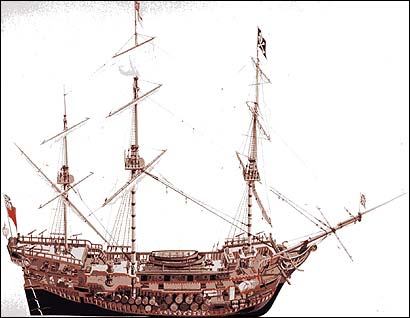

A drawing of the Whyda, the pirate ship that John King is believed to have been sailing on when he died. (Expedition Whydah Sea-Lab & Learning Center)
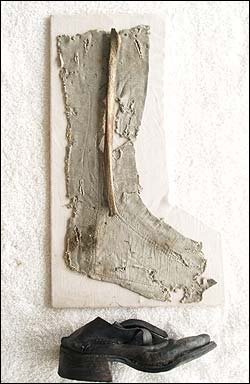
The silk stocking, shoe and fibula believed to be John King's, found in the wreckage off Wellfleet. (Expedition Whydah Sea-Lab & Learning Center)

Tuesday, May 30, 2006

I Heard I Was In Town

Now that I am back from the land of milk and honey that is Tillerman's house and back in Massachusetts I guess I should write a post about the weekend. The drive down was fairly uneventful, which is good because it was the first long highway trip for the new trailer and the first long trip with Tillerman's "cutest grandaughter in the world".

OG, I wonder if you will see an increase in hits on
LiveSailDie.com after the prominent display of my sticker on the back of the trailer all the way down I-95 from Massachusetts to New Jersey.

We did get pulled over in Connecticut on the Merritt Parkway because apparently trailers are not allowed on that road despite there being no signage to that effect and even though Tillerman has driven it several times with his trailer with no problems.

On Sunday morning, Tillerman and I drove down to Spruce Run for the regatta. It was hot and there was no wind, but I was happy to be at an actual regatta again. As the cast of characters gradually showed up I actually recognized some of them from Tillerman's post. Since sailing in Laser regattas on the Jersey Shore with Tillerman when I was in high school, I have tried to avoid him when he tries to tell me who the hotshots are...I didn't want to be intimidated by knowing that: "that guy won the North Americans a few years ago" or "he is doing an Olympic campaign". It was usually pretty obvious who you didn't want to try to beat off the start line and who would be an easy target. The "Collander Cup" (as it is now known) was nothing like those Jersey Shore regattas. It was more like sailing Sunfish on my old home lake; the guys to watch were the old retirees and the local hotshots who had the local knowledge.

I made sure I was the first boat to launch and commenced drifting out to the start line. I felt really clumsy in the boat and tried to do some roll tacks to get used to the feel of a Laser again. Eventually the rest of the fleet made it out to the line and after some course adjustments the committee started the first race. There was no wind at the start but it filled in at the pin end leaving Tillerman, Local Hotshot and me at the boat end watching the Kid and the rest of the fleet ghosting along. By the windward mark I was buried at mid-fleet with little hope of catching up on the downwind in a drifter. Just as we rounded the leeward mark, a breath of breeze appeared...and the fleet started to make mistakes. My cardinal rule in conditions like this is POINT AT THE MARK, so I just stayed on the lifted tack and gained three boats on the last beat to finish third.

The rest of the morning was more of the same drifting conditions with almost no opportunities to make strategic gains except at the start and at mark roundings. Tillerman was leading the third race at the windward mark in absolutely no breeze when the race committee drove around in their skiff to take a vote on whether to abandon the race. No decision was made though, the wind filled in nicely and Tillerman finished in second. Despite the best wind of the day, the race committee sent us in for lunch; hot dogs courtesy of the Jet 14 fleet.

By the time we had finished lunch the wind had died again, so I headed back out to the course by standing on the bow and rocking the boat with the rudder flipped up. As Tillerman pointed out, I fell off the bow while circling around the committee boat waiting for the rest of the fleet to arrive...I can't wait to see the photo taken by the fleet webmaster. The afternoon conditions were more drifty than the morning but somehow I managed to find myself first at the windward mark twice...Local Hotshot was too good for me though and he beat me in both races. I managed to fall/slide off the boat again while sailing downwind...upon reflection my shiny boardshorts were probably not the best attire for Laser sailing.

I had low expectations for the regatta considering it was my first Laser regatta in 9 years, that I am easily 45 lbs overweight for Laser sailing, and that the conditions were so light but after everything was done I was somehow in 2nd place overall. Not bad...maybe I did learn something from all that college sailing that I managed not to forget since then. I have plans to attend some more competitive regattas this summer as well as my usual Star sailing. Hopefully the rest of the regattas will be as enjoyable as the "Collander Cup".

Friday, May 26, 2006

Interesting Artist

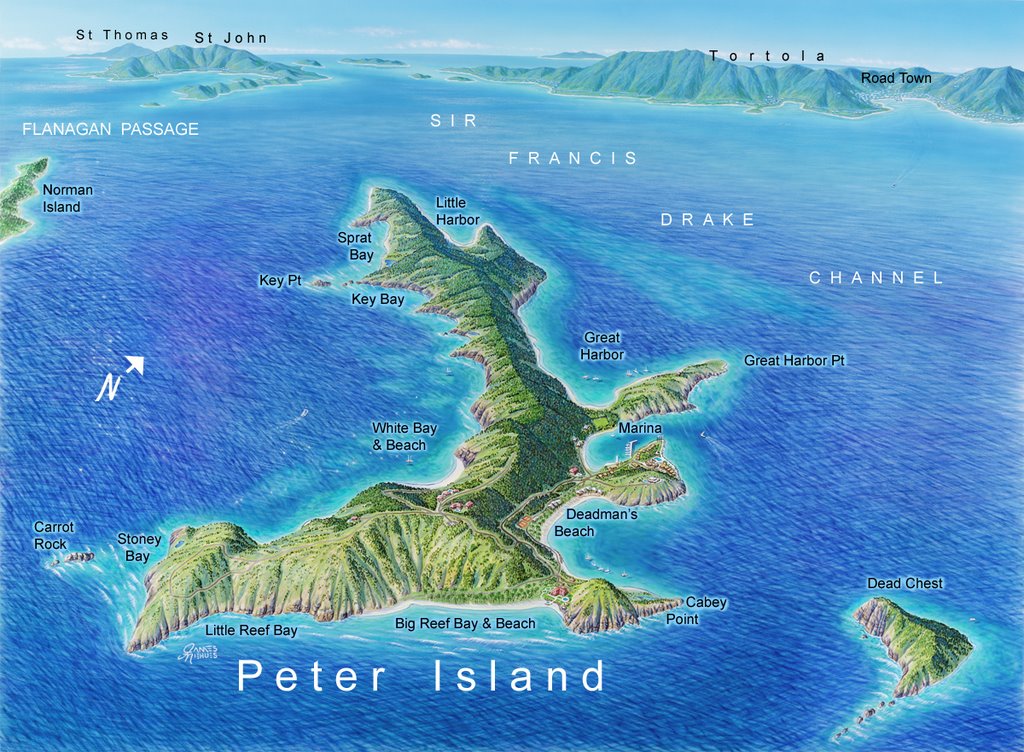
I was surfing the web and came across an artist whose work looked familiar for some reason. His name is James Niehues and he is the artist who painted the images for the trail maps of many of my favorite ski areas. I had always been curious why the trail maps for many ski areas looked so similar and had guessed that perhaps they were computer generated. It turns out that the reason they look similar is because the same artist painted them all. He also does artwork for other resorts including this image of Peter Island in the BVI:

Friday, May 19, 2006

A Quote from OG

To quote one of my online sailing friends, OG from LiveSailDie: (this was written on Friday May 12th and was probably originally intended for some other purpose, however it seems perfect for this situation...)
To feel the wind in your hair and the salt on your face is one of the most exhilarating experiences one could ever be succumbed to. Sailing into the sunset with the horizon your destination truly provides a sense of living. When no one else can be seen, no land, birds or passing ships, you know you are experiencing one of the many wonders the sea and the world has to offer…

Sadly, not everyone can enjoy this natural pleasure…

It has been a rough few months of horrible experiences, and just again today, additional bad news was cast my way. More tears fell from eyes that once glistened in the day and moonlight and the statement “if only” again passed through my mind.

Life is too short to stay dry…

Life is too short to stay grounded…

Life is too short to stay on your island so please sail the waters in and surrounding your land.

Talk of times on the water, and share with land dweller the joy of the sea. Pass on wisdom of the winds and stories of knowledge of nautical ways…

For there are far too many in this crazy mixed up world who live and die but never experience the pleasure of sail…

So please… Live each day… Sail the Seas… Then, and only then, should you rest your head and Die…

Thursday, May 18, 2006

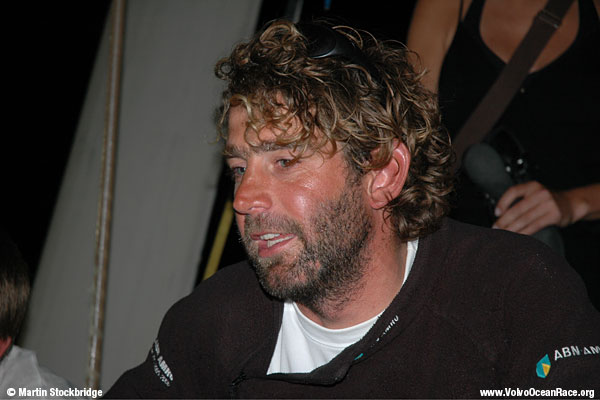
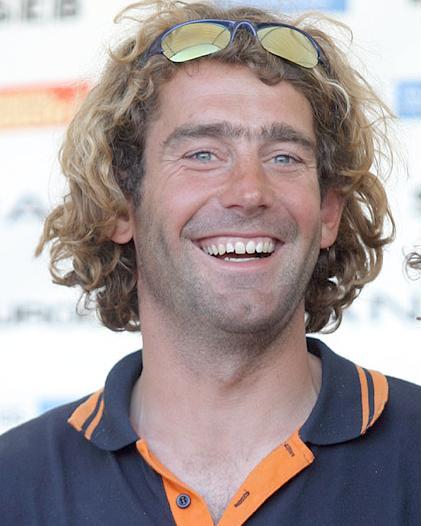
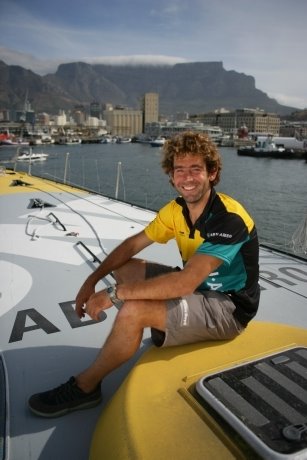
Hans Horrevoets

Hans was only 3 years older than I am now. He also has a young daughter (his is 11 months old, mine is 5 1/2 months old).

I suppose as armchair and internet sailors we had become used to these boats sailing around the world at incredible speeds with no casualties. Given a few changes in my own sailing history I might have been in Hans' place. Perhaps my summer job with Young America could have become more than it was...maybe if I had taken that job in Maine as a sailing coach and sailmaker...I might have had the opportunity to sail in the Volvo Ocean Race.


Although Hans' tragic death makes me feel thankful for my safe life here in Massachusetts, where the most dangerous thing I deal with is the traffic on I-95 on the way to work, I am still envious of his courage in pursuing his dream.

It's tough when someone so young loses their life...but at least we can take comfort in the fact that Hans was chasing his dream.

Tragedy

Amsterdam, 18 May 2006

ABN AMRO expresses deep regret over tragic accident in Volvo Ocean Race


With deep regret ABN AMRO confirms that Hans Horrevoets, crew member of ABN AMRO TWO, was killed in an accident as the boat made its way to Portsmouth. Hans was swept overboard early this morning, as his boat battled its way through five metre seas and 30 knot winds. The boat was about 2,000 kilometres from land. His fellow crew members immediately turned around and began to search for him, meanwhile raising the alarm on shore. In the most difficult of conditions, they succeeded in finding Hans. He was lifted back on board, and attempts were made to resuscitate him – but these were not successful.

Rijkman Groenink, Chairman of the Managing Board of ABN AMRO, said: "We are all devastated by this terrible accident. Over the past year and a half, from preparation to where we are now, the crew members of TEAM ABN AMRO have become an integral part of the ABN AMRO family. We shared in the excitement leading up to the race and celebrated our achievements since the race began. Now, in this tragic moment, our thoughts are with Hans' family, and also with his fellow crew members."

The crew is no longer in racing mode and is making its way to land as quickly as possible. A decision on further participation of ABN AMRO TWO in the race will be made during the Portsmouth stopover.

Saturday, May 06, 2006

Rule 42


Do you you think it is too early to teach her that she can only pump once per wave?

Thursday, May 04, 2006

Check the bottom of your rum!

BUDAPEST (Reuters) - Hungarian builders who drank their way to the bottom of a huge barrel of rum while renovating a house got a nasty surprise when a pickled corpse tumbled out of the empty barrel, a police magazine website reported.

According to online magazine www.zsaru.hu, workers in Szeged in the south of Hungary tried to move the barrel after they had drained it, only to find it was surprisingly heavy and were shocked when the body of a naked man fell out.The website said that the body of the man had been shipped back from Jamaica 20 years ago by his wife in the barrel of rum in order to avoid the cost and paperwork of an official return.

According to the website, workers said the rum in the 300-litre barrel had a "special taste" so they even decanted a few bottles of the liquor to take home.

The wife has since died and the man was buried in a proper grave.

Friday, April 28, 2006

I actually went sailing!

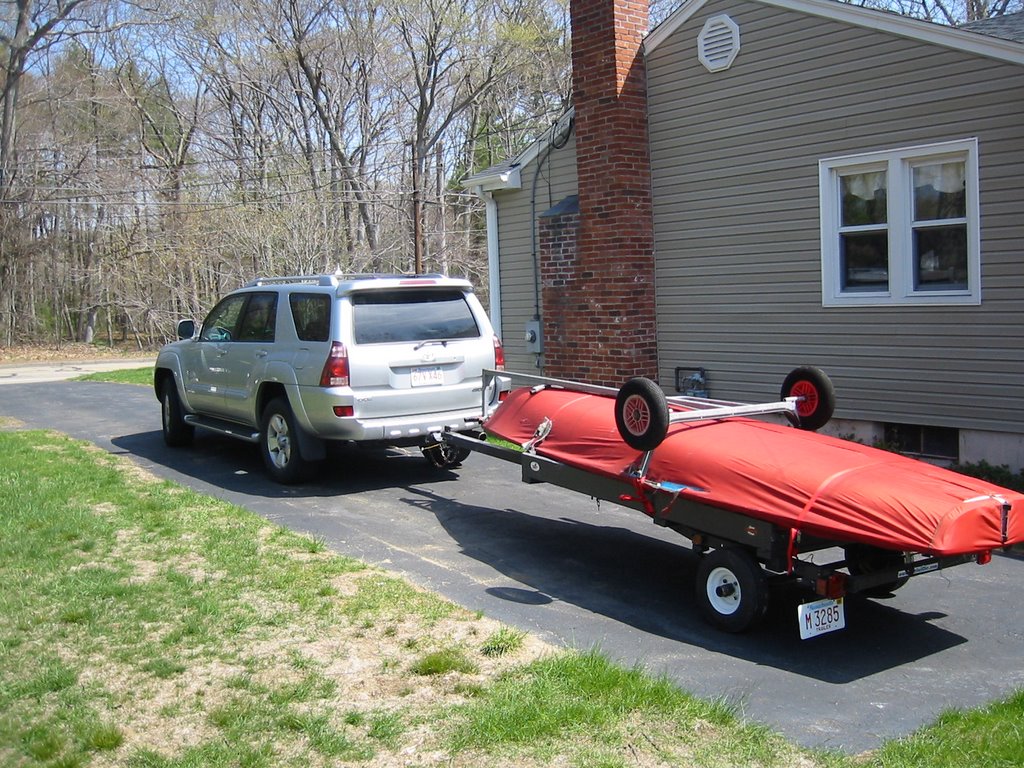
Avid readers (are there any?) of this blog will have noticed that I have not actually gone sailing since I started writing last fall. Well, yesterday I finally hooked up the new trailer to the car:
And went over to Lake Massapoag:
I launched the boat from the boat ramp in the photo above. The wind was a shifty and variable northeasterly. While I was rigging, the local high school sailing coach Bob showed up. He had noticed my sail and decided to see who the crazy sailor was. He invited me to come along to the Thursday night Laser racing and also the Sunday handicap racing. So now I can race on a lake within 10 minutes of my house.

Oh, and here is a photo of the LiveSailDie sticker on the back of my trailer for OG.

Wednesday, April 26, 2006

Interesting Story from the Horse's Mouth

I came across this interesting story from Joe Rouse at The Horse's Mouth:

"Darwin's Law Circumvented by USCG"


Last Thursday we were doing the California Bash up from San Diego
approximately 10nm off Carmel. While monitoring ch. 16 I heard a
vessel doing long counts to ten for a USCG helicopter. The skipper
was saying, "ONE...TWO...THREE…" etc. They repeated this three
times over the course of about 20 minutes. I figured that the helo
was trying to home in on their location using RDF. This sounded
like some kind of emergency so I stayed tuned.

After a few more minutes I discovered that the sailing vessel
Celcion (Celcion is Latin for "are we there yet") was lost and that
the helo was on its way to lend assistance. Upon finding the
desperately lost voyager the helo then hovered overhead in order to
provide the adventurous captain with his lat/long position. The
coordinates were repeated several times due to mis-something. The
skipper then asked where he was. The USCG helo said "you're six
miles from Monterey." The skipper mumbled something about wanting
to go to Half Moon Bay and "could you point me in the right
direction, and I think I have a "map" of Monterey someplace". The
helo pilot was not about to give this guy directions, and wisely
so. He strongly urged the captain to seek an escort into Monterey
for the evening (sunset was another two hours away). The skipper
accepted even though he was a wee bit embarrassed at this point.

The pilot contacted USCG Monterey and requested a rescue boat be
dispatched to the scene. I being only about 8nm away also offered
my assistance. The pilot asked if we could steam towards Celcion's
position and act as another asset if needed. We agreed to do what
we could.

About 45 minutes later the USCG rescue boat arrived. We were now
3nm away from Celcion. Communication between the coasties and the
skipper were a little confused. The coasties asked several times if
he or his crew had suffered any injuries. The skipper finally
understood and said "Only my pride". Eventually the coasties
escorted this rather fortunate skipper and his crew into Monterey
for the evening while we went back to bashing up the coast.

Joe's comments were:

"It appears that the skipper of the Celcion left SF Bay for a trip to
Half Moon Bay and wound up near Monterey totally lost and confused.
I wonder if this is how Gilligan's Island started?

1.5 Hours of USCG Helicopter flight time = $20,000
3 Hours of USCG rescue boat time = $5,000
Spending an unexpected weekend in Monterey with the help of US
taxpayers and the Coast Guard = PRICELESS"

What I don't get is why the bill for Coast Guard service in frivolous situations like this is not sent along to the owner or operator of the vessel in trouble. When skiers get themselves in similar situations they are often billed for the cost of their rescue, even in the US. A quick Google search yielded an example from from Vermont where each of the four skiers involved was assessed $4,177.87 to cover the cost of the rescue from the woods near Killington. For ski vacations in Europe, travellers can take out insurance to cover the high cost of a potential rescue.
Why should taxpayers cover the cost of the mistakes of an inexperienced sailor in a similar situation?

Friday, April 07, 2006

Sunfish

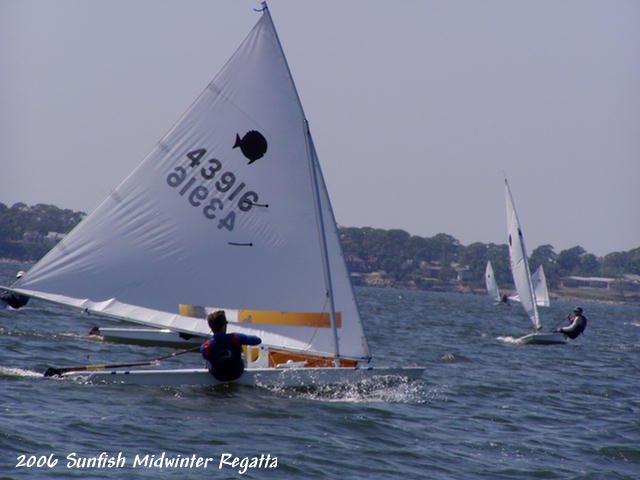
One of the local sailors I sailed against as a junior did very well at the Sunfish Midwinter Championship. He was always the young hotshot on our local lake and has apparently learned alot from sailing Lasers with Tillerman in Connecticut.
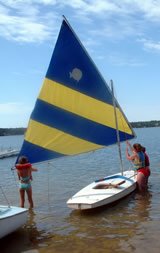
The Sunfish is a strange little boat but it has a very loyal following among what is now becoming an older group of sailors. Unfortunately there is not much respect to be had when boasting of success in a Sunfish among sailors from other classes. When you tell someone that you raced Sunfish when you were growing up, the image in their mind is more likely to be:


Rather than:

Despite its cheesy reputation, the Sunfish is an interesting and tricky boat to sail. The sailplan is different on port and starboard tacks because the sail is rigged on the port side of the mast, the whole rig is very wobbly and can easily be shaken by aggressive body motions, the hull has hard chines and in some conditions sails well when heeled to leeward so that only one chine is in the water, and the sail controls are rudimentry and not very effective.
Interestingly, when I started sailing a Star there were some parallels between the two boats. The main similarity is that the boom on both boats is very long and low to the deck which makes tacking interesting and allows for a kind of aerodynamic "plate" effect at the bottom of the main. And the other is that the rudder on both boats is relatively small and can stall out easily.

Tuesday, April 04, 2006

Wind Shadows II

My post on wind shadows sparked off a stream of comments from Tillerman. At first I thought he was trying to trick me into saying something incorrect, but it seems he was just trying to figure it out for himself.

Tillerman said...

So are you in another boat's wind shadow when its wind indicator is pointing at you, or when your wind indicator is pointing at them?

4:30 PM


Litoralis said...

Wind indicators point to windward, but they are affected by apparent wind, so a more accurate description would be that you are potentially in someone's wind shadow when you are on the imaginary line drawn straight downwind from the windward boat's sail plan.

5:11 PM

Tillerman said...

But is it a line straight down the true wind direction or straight down the apparent wind direction of the windward boat?

5:17 PM


Litoralis said...

I think it is straight downwind. I visualize wind shadows as holes in the wind that extend downwind from the sail plan of the boat.

5:47 PM


Tillerman said...

Straight down true or straight down apparent wind?

6:11 PM


Litoralis said...

Straight downwind. The wind shadow is not shifted by the movement of the boat in my mental model.

If you imagine a fast boat like a catamaran sailing on a broad reach (with respect to the true wind direction) but with the sails trimmed in to his apparent wind direction. The wind shadow of the catamaran must still extend downwind. If it extends along the apparent wind angle then it would extend upwind. There will be a region of turbulent air following the path of the boat, but this is turbulence, not a wind shadow.

Also, imagine a large powerboat moving quickly in a direction perpendicular to the true wind direction. It will still have a wind shadow extending downwind from its beam even though the apparent wind angle on the boat is the same as its direction of travel.

6:33 PM


Tillerman said...

Good points. So is Dellenbaugh talking out of his yahoo in saying that the wind indicator gives you a "very accurate idea of which way the boat's wind shadow extends"?

7:38 PM


Litoralis said...

The wind indicator method suggested by Dellenbaugh is a good simplification for downwind sailing in slowish boats.

What does everyone else think? How do you visualize wind shadows? Am I correct about wind shadows extending directly downwind?

Monday, April 03, 2006

Wind Shadows

(Following is a brief excerpt of a story by David Dellenbaugh posted on the Sailing Breezes online magazine.) Wind shadows, like the wind itself, are invisible, so you have to look around for clues in order to know where they are. Your best tool is undoubtedly the wind indicator on top of your mast (or on the mast of a boat to windward). This pennant shows the apparent wind direction and will give you a very accurate idea of which way the boat's wind shadow extends. In addition to determining the angle of the wind shadow, it's important to know its size. There are many factors that affect how large an area is covered by a boat's disturbed air. These include the wind velocity, height of the mast and speed of the boat. The length of a wind shadow is often measured in "mast-height" units rather than in boatlengths. For example, in heavy air a boat's wind shadow might extend four mast-heights to leeward. In light air, that same boat might cast a wind shadow for eight or more mast-heights. ... - David Dellenbaugh

Tuesday, March 28, 2006

Stripey Sails

When I worked for Young America as a summer job while I was in college, one of the things I was working on was digitizing sail shapes. Digital photographs were taken of the sail from the deck and then I used a computer graphics program to convert the sail shapes into digital files. The digitized sails were compared to ideal digital sails for each wind strength. To digitize the sails I had to click on the photos to make dots along the draft stripes. The problem was that the black draft stripes were difficult to discern especially near the top of the sails. At the time, the sails were light colored, so black stripes were the only color choice. I made a suggestion that white stripes on black sails would be easier to digitize, but obviously the sail material could not be redesigned just so I could digitize the stripes more easily.

Now that the sails on these boats are almost black, it looks like the draft stripes are both white and black to provide more contrast. I also suspect that the software used to digitize the sail shapes is now automated, so there would no longer be a need for a college kid like me to look at photos of America's Cup sails all day long. Even at the time I was working on the sails, the team was working on permanently mounting cameras in the deck and on the spreaders to make the photos more consistent.

Saturday, March 25, 2006

The Trailer Is Finished

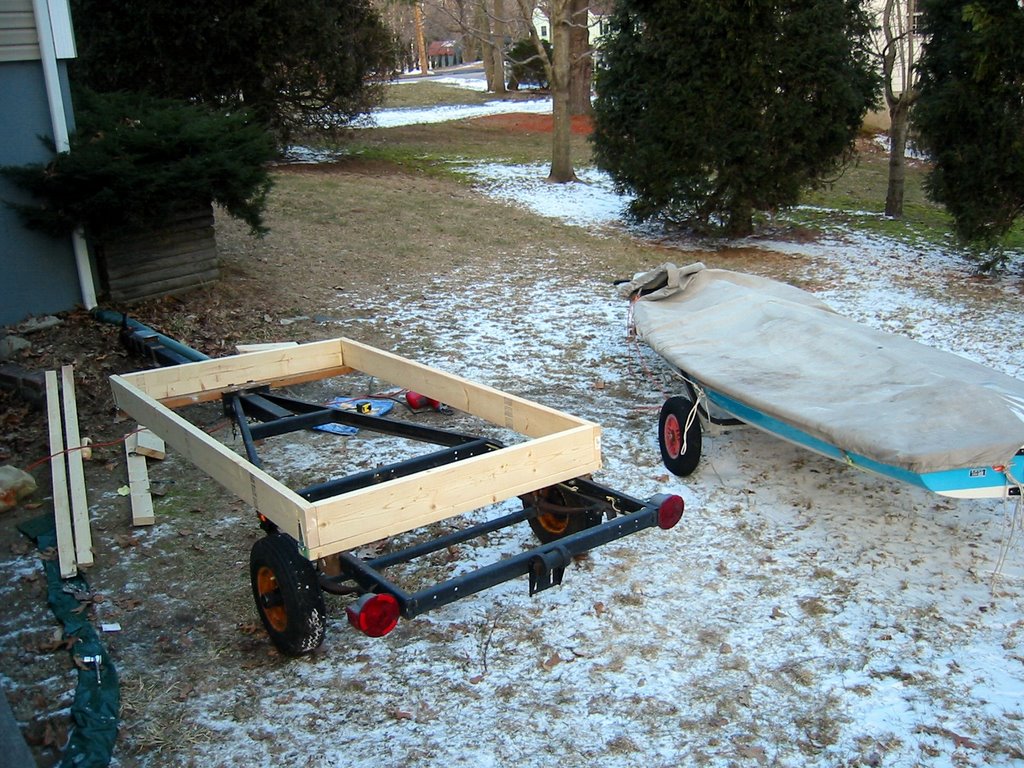
I have been working on my trailer for a while now. The trailer started out with two simple supports:


I wrote about building the box back on February 26th.


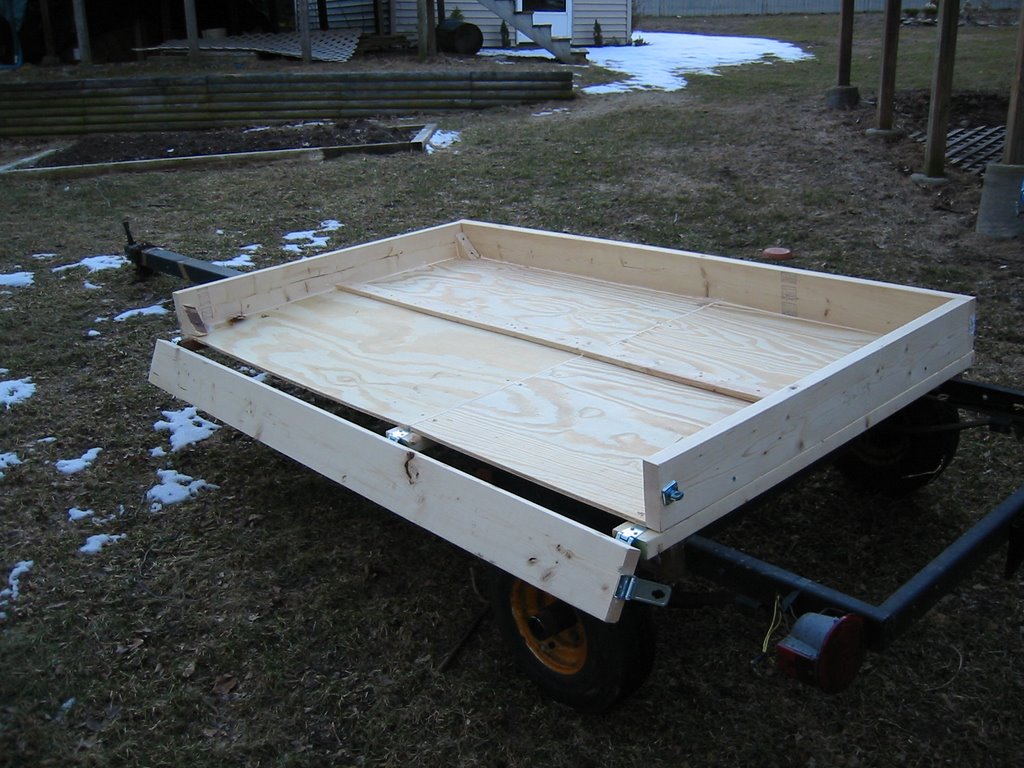
I added the plywood base to the box on March 5th.

Note the hinged side to allow gear to be removed from the box while the boat is on the trailer.

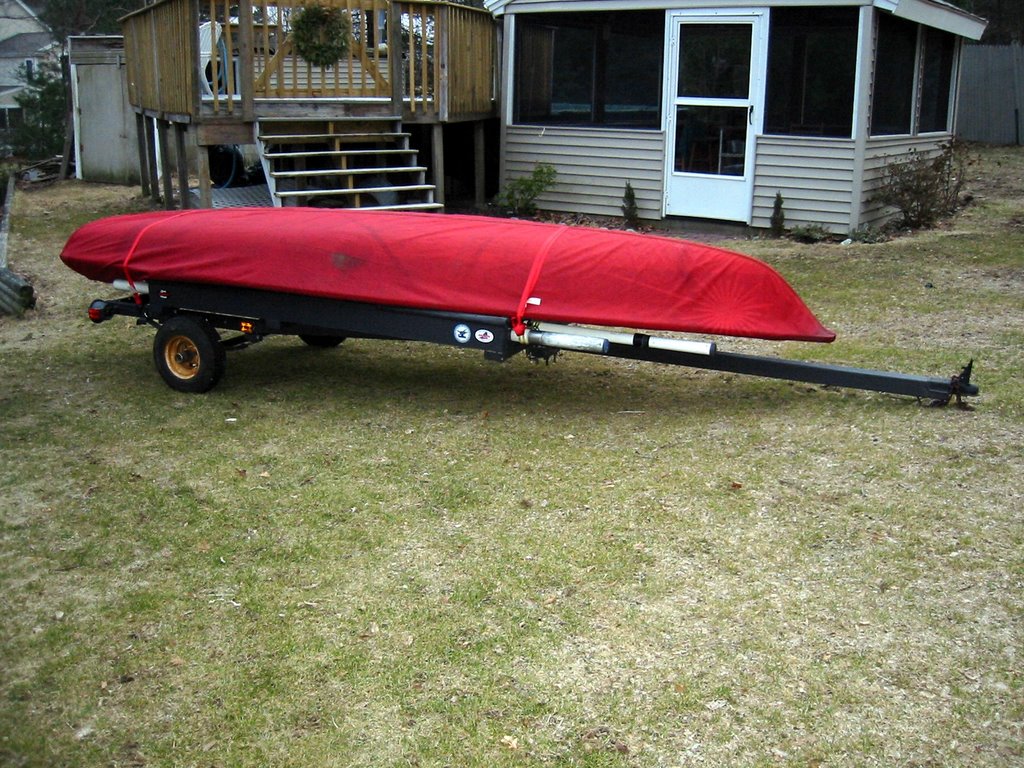
Last weekend I painted the entire trailer and today I put the finishing touches on it.
The supports are shaped to match the curvature of the deck. The non-hinged side of the box is padded so that I can lift the boat on and off the trailer by myself. I will be adding a LiveSailDie sticker to the back of the trailer as soon as the paint is completely dry.

Friday, March 24, 2006

E. Works Her Abs

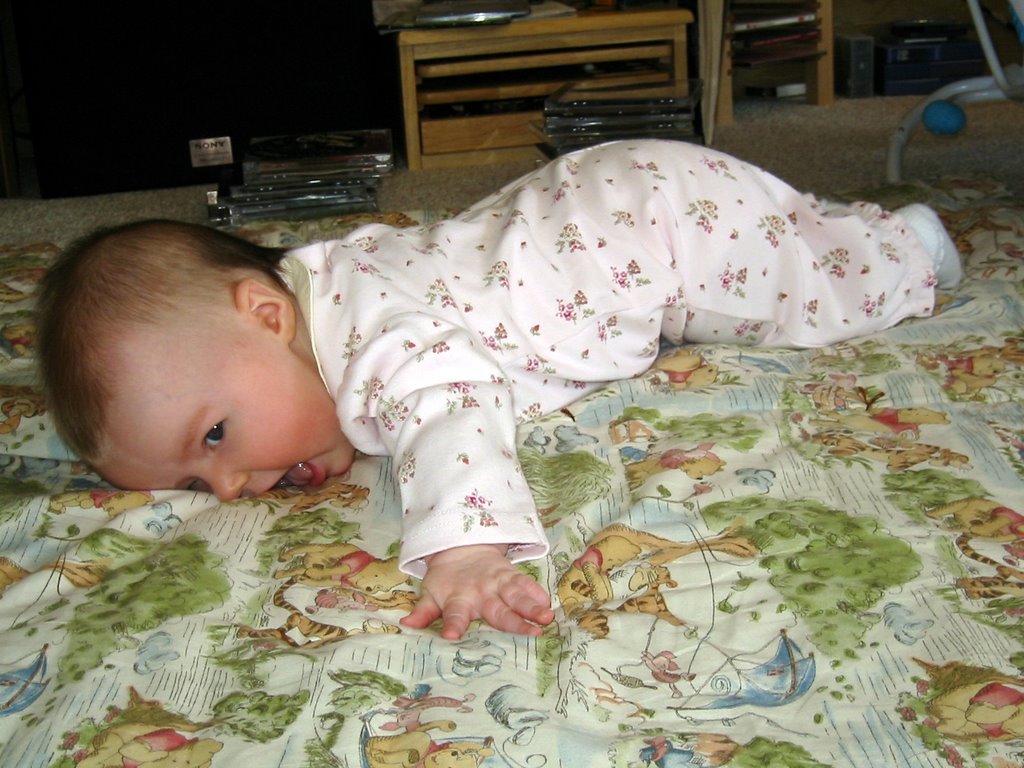
E: Daddy, I have been working on my abs for a few weeks now (check out this photo of me working on my obliques)...when can I come sailing? I am ready to hike hard!

Litoralis: I think you had better work on picking up your head first. Don't worry there's plenty of time for sailing.

Friday, March 17, 2006

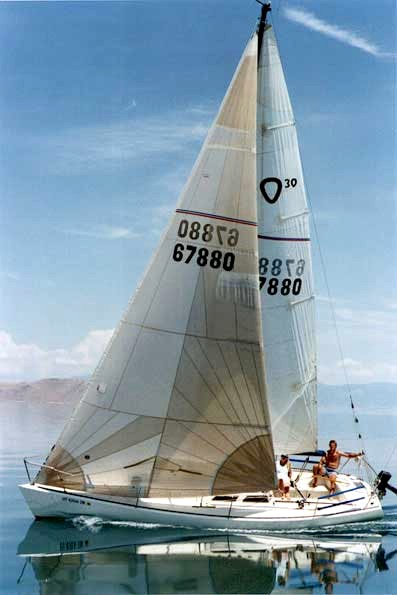
Photo Quiz: What's Happening in this Photo?

How come this boat is cruising along nicely even though there is no wind?

Saturday, March 11, 2006

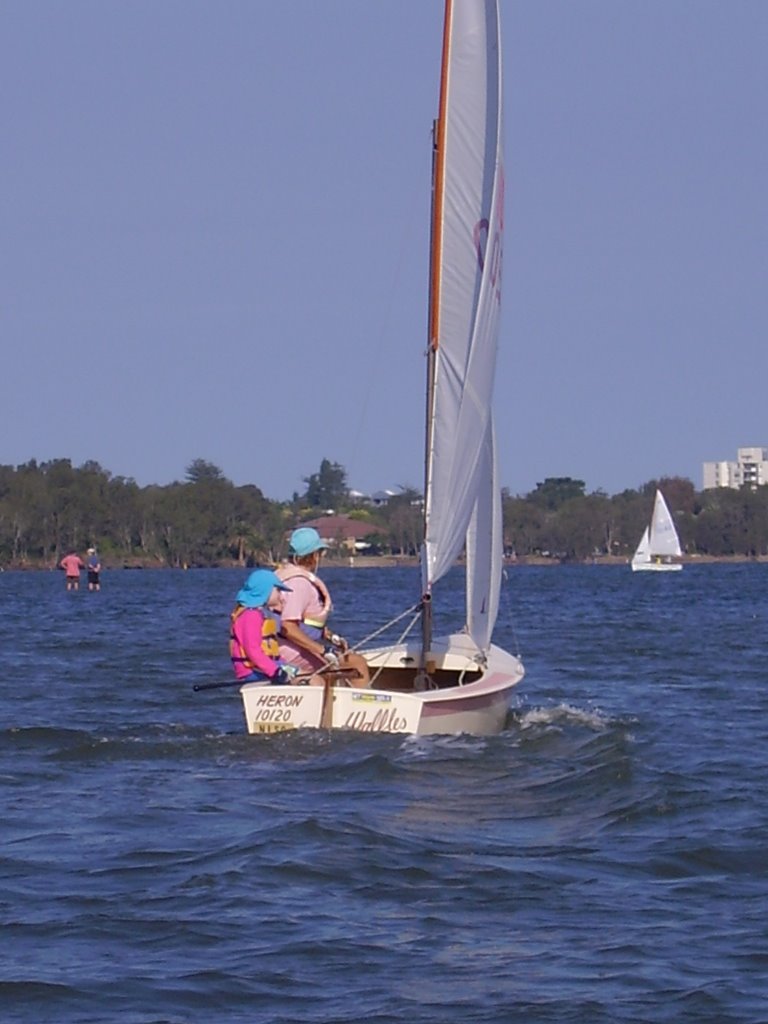
Daddy, do we leave those people to port or starboard?

Narrabeen Lakes Sailing Club, New South Wales, Australia.

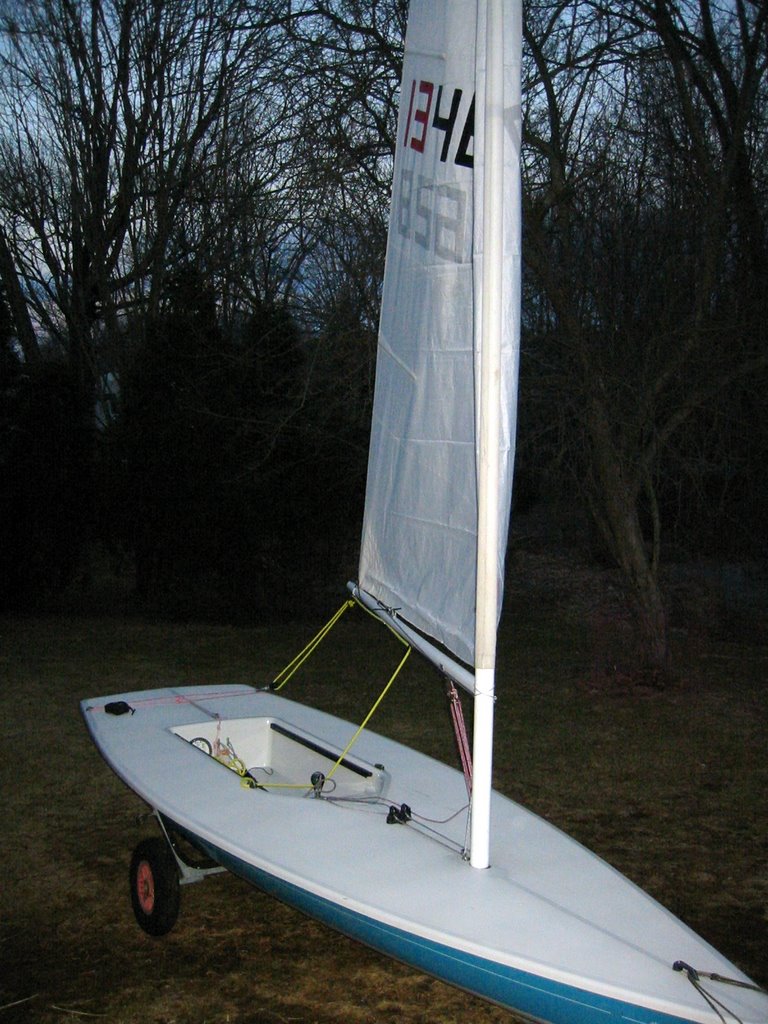
What is that in your backyard?

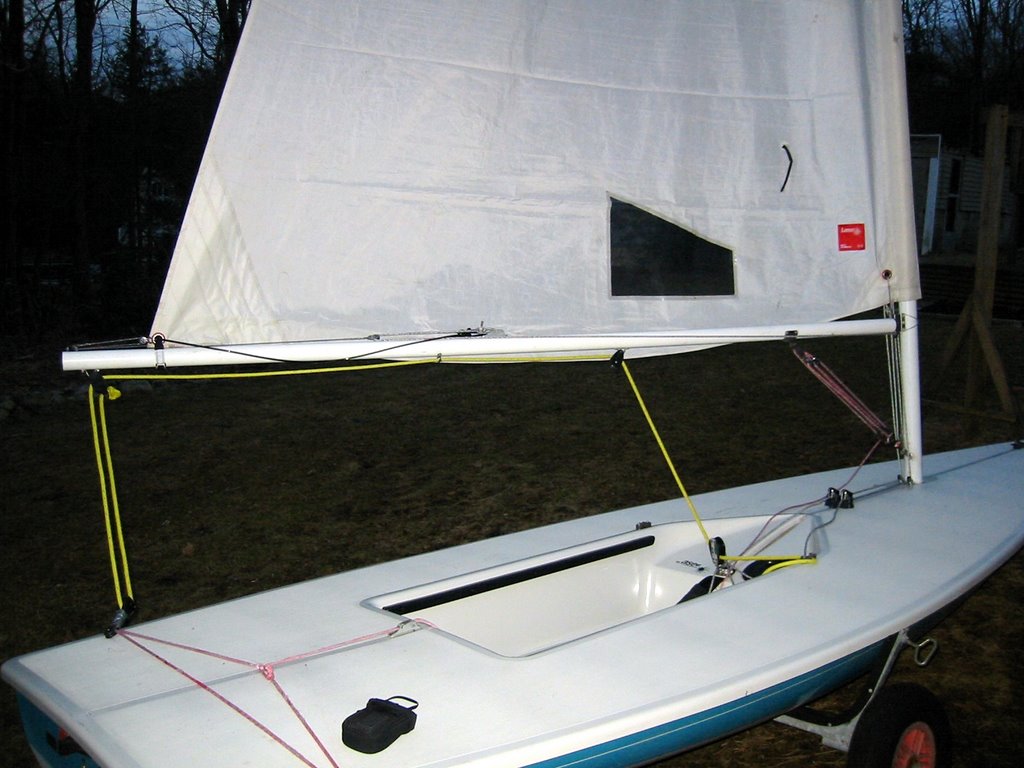
The weather was warm today, so I tackled the new rigging on the Laser. I removed the old cunningham fairlead and jam cleat, and installed the new turning blocks and cam cleats.
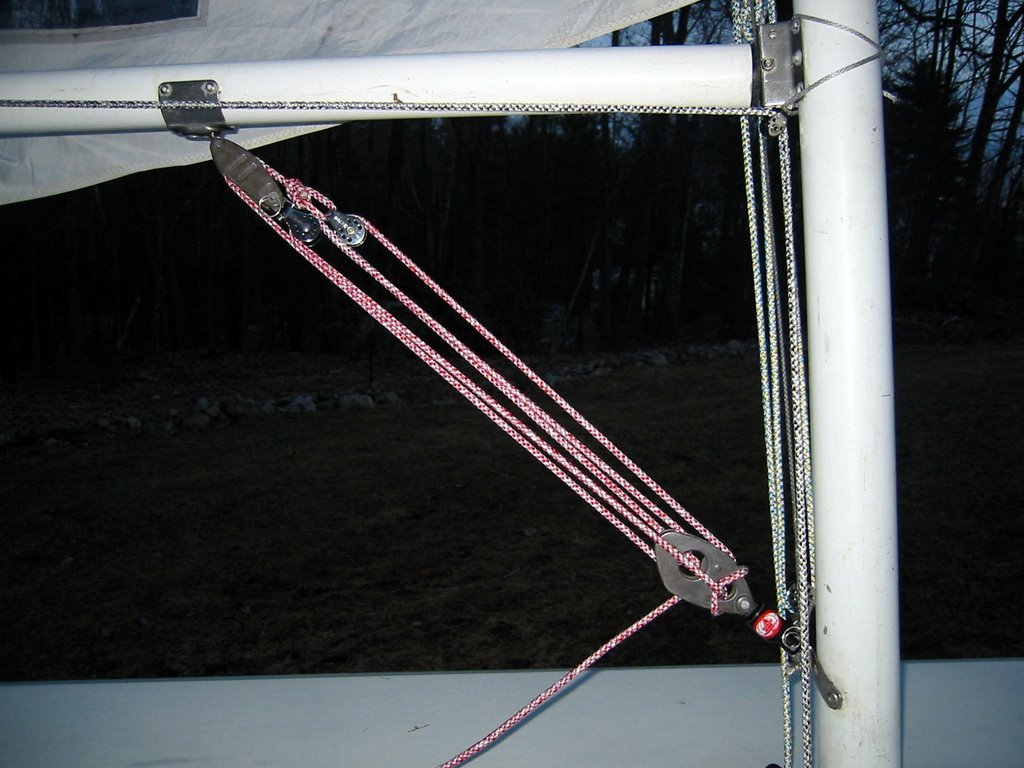
I rigged up the new vang, cunningham and outhaul. The Maffioli NewSwift is really nice. It's flexible enough to run through the blocks easily, but it is not too floppy. All the blocks are attached to the Spectra with spliced loops...no more annoying bowlines.

6:1 Cunningham

6:1 Vang